










ACCESS - IP / Internet Digital Audio Codec
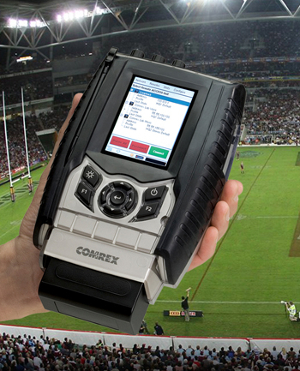
The industry-standard ACCESS from Comrex is a true revolution in audio codecs. Developed from the ground up for use over the public internet, it provides 2-way, stable, stereo, low-delay audio over pretty much any type of internet connection, including wireless systems such as WiFi, 4G and 3G. A pair of rackmounts will provide a superb ISDN replacement whilst the portable unit effectively gives you a radio car in the palm of your hand! It literally is as good as it sounds and is being used by a huge number of broadcasters worldwide.
ACCESS is the first codec to use BRIC (Broadcast Reliable Internet Codec) technology to deliver wideband audio over the public internet and other IP networks in real time. It includes AAC algorithms from Fraunhofer IIS - such as the remarkable AAC-ELD - which provide near-transparent audio transmission. There is also a built-in linear uncompressed mode and FLAC lossless audio coding, suitable for managed networks with a high Quality of Service. Because the ACCESS constantly adapts to changing network conditions, audio delay is kept to a minimum whilst maintaining audio stability.
ACCESS is just as happy running 2-way 15kHz mono over a standard phone line (POTS) and is compatible in this mode with the Matrix and Vector.
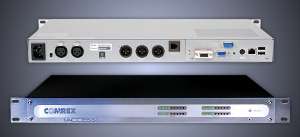
The ACCESS rackmount is a 1U unit with analogue stereo audio inputs and outputs plus digital AES on XLRs. There are also serial and GPI ports which can be sent alongside the audio to the connected unit. A standard phone line connection and Contact Closure completes the rear panel.
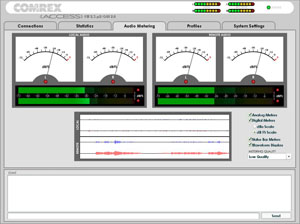
The front panel contains only level indicators and a status LED. All setup and connection functions, as well as detailed status, audio levels and network statistics are accessed through the user-friendly web interface. Operation is as simple as selecting a remote unit from the 'address book' and clicking Connect, while advanced configuration menus are available for power users who wish to configure all aspects of the audio coding process.
Apart from normal point-to-point connectivity, ACCESS also supports multi-streaming, IP multicast and SHOUTcast™ connections. In addition, the HotSwitch application provides "live" audio switching between a number of remote codecs, all connected simultaneously to the studio and receiving either program audio, talkback or clean feed.
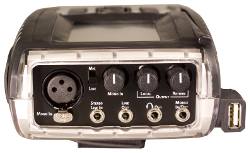
The ACCESS Portable is the perfect complement to the Rackmount and provides the same technology in a handheld, battery-powered unit not much bigger than a PDA. The Portable includes two USB sockets for use with WiFi adapters and 3G/4G cellular 'dongles', making it easy to get an IP connection from a wide range of locations. With current UK mobile data tariffs, you can use the ACCESS over 3G for just £1 per day!
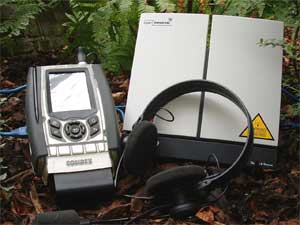
ACCESS and BGAN Satellite Terminal
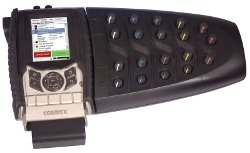
The algorithm best suited to the network available can be selected from either the Rackmount web GUI or the built-in touch screen on the Portable. Audio meters are displayed on the Portable's screen and a web browser is included to allow easy connection to WiFi hotspots where a password or credit card number is required. An optional 5-channel mixer is also available, turning the ACCESS Portable into a fully-integrated remote audio solution.
For use in the most remote locations, the ACCESS units will even work seamlessly with a satellite terminal to provide the same high-quality audio expected of the BRIC and AAC algorithms from almost anywhere in the world using the Inmarsat BGAN (Broadband Global Area Network) service. For more information please contact us.
Features
-
Compatibility with a wide variety of wired and wireless circuits including:
- Domestic and business DSL, POTS and cable
- 802.11 WiFi networks (e.g. Public WiFi hotspots) and WiMAX
- 4G / 3G / UMTS / HSPA mobile data networks
- Satellite services such as VSAT and BGAN
- Standard AoIP/VoIP and AAC algorithms cater for all types of IP connection with low delay audio from 7kHz mono to 20kHz stereo or dual mono
- Linear PCM uncompressed and FLAC for lossless audio over managed networks
- N/ACIP (EBU Tech 3326) SIP compatible connections are supported (except Layer-II) for interoperability between codecs from different manufacturers
- 'Set and forget' Rackmount unit for studio use; lightweight Portable unit for use on the road
- Easy to use web-based configuration and control of Rackmount unit and built-in touch-screen interface with web browser for Portable unit
- Optional 5-channel mixer available for the ACCESS Portable
N/ACIP SIP / EBU-3326 Codec Compatibility
The N/ACIP international committee was set up by the European Broadcasting Union to hammer out a common protocol to interconnect codec brands and resulted in EBU Tech 3326, a technical document describing how best to achieve this goal. It defines several encoding algorithms plus the transport layer and incorporates the SIP protocol that determines the handshake that takes place at the start of an IP codec call. ACCESS and BRIC-Link codecs already include SIP compatibility which also has the advantage of making them compatible with other non-broadcast products such as VoIP hardware, software and mobile phone apps such as CSipSimple for Android phones and Media5-fone for iOS. ACCESS and BRIC-Link do not fully comply with EBU3326 as they do not feature MPEG Layer-II but apart from this, they have been tested to be compatible with several other manufacturers' devices using encoders supported by both products. In general, when connecting between Comrex hardware, it is best to use one of the proprietary modes which take advantage of other algorithms and special features such as BRUTE (UDP Reliability and Congestion Avoidance).
BRIC-TS - Traversal Server
The BRIC-TS Traversal Server is hard to describe but an extremely useful development as it enables connections to be made between BRIC-enabled devices, such as ACCESS and BRIC-Link codecs, quickly and simply.
A codec connected to a local network will usually be 'hidden' from the outside world behind an IP firewall or router, which makes accepting incoming calls from an external unit troublesome without some re-configuration of the network. However, by first making a connection to the BRIC-TS Traversal Server, a codec can "punch a hole" through the firewall, providing a return path by which other codecs can connect in. The Traversal Server keeps a record of the route by which data needs to travel to reach each registered codec, allowing users to call another device by "name" rather than by "number" (or IP address). The audio does not pass through the server - only the IP addressing is handled by it. Imagine being able to call into a portable that is on a 3G network or a codec that is connected to the internet at a WiFi Hotspot!
To take advantage of the BRIC-TS Traversal Server, you will need to buy a licence for each ACCESS Codec you wish to register. This is a one-time cost and the licence code is entered into each codec via the normal user interface. You get an account of your own on the BRIC-TS Server where you can see the status of each codec (idle, connected etc), its software revision and other useful information. On each codec's screen, you see a list of all other units by name and whether they are available, allowing connections to be made instantly without having to enter any details manually.
Optional Road / Flight Cases
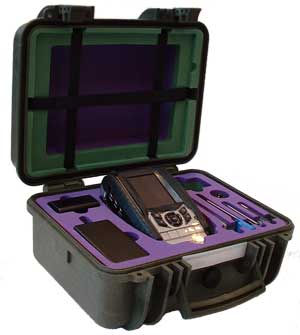
AX-ROAD-EX – For ACCESS Portable and Accessories
Olive Green waterproof Explorer case made from high impact poly-ethylene and rugged enough for even the most severe and hazardous environments, fitted with high-density foam to take the ACCESS Portable, 1 battery and 1 spare, mains power supply, USB WiFi adapter, POTS modem and 4G / 3G dongle, with ancillary cables and manual held in the lid by Velcro straps.
Overall dimensions are 360 x 305 x 195mm approx (W x D x H) and the weight is 2.75kg (empty) or approximately 8.5kg with equipment. There are two snap-shut catches to close the lid and the moulding incorporates provision for a padlock.
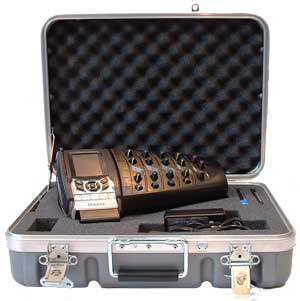
AX-ROAD-MX – For ACCESS Portable With Its Mixer and Accessories
Silver-grey Comrex high impact ridged plastic case with aluminium frame and sturdy fasteners, rugged enough for the cargo hold of an aeroplane. Custom foam for the ACCESS (also available for the Vector/Envoy, Matrix or Hotline/Nexus) accommodates the ACCESS Portable with 1 battery and 1 spare, USB WiFi adapter, POTS modem and 4G / 3G dongle, mains power supply, cables and headphones etc. A pre-cut area of foam can be easily removed to accommodate the AX-MIX add-on mixer. With the cover closed, there is space for manual and other items between the foam.
Overall dimensions are 495 x 395 x 215 mm approx (W x D x H) and the weight is 12.5kg (empty) or approximately 18.5kg with equipment. There are two wind-down catches to close the lid and provision for a padlock.
Data Packages – Unlocked 4G / 3G Dongles and Paid-up Data Bundles
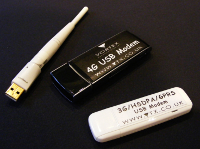
For the ACCESS to connect via 4G / 3G (UMTS), a suitable plug-in USB modem 'dongle' needs to be used. We have a lot of experience with mobile connectivity and are happy to share this information with customers.
In most situations, it is possible to choose a data network that will provide suitable performance in a particular geographical area but it can be very convenient to be able to use a different network from time to time. This is particularly important when roaming, where data charges can be extremely high, and when away from base where another network may provide better coverage.
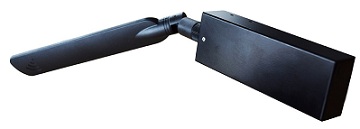
Comrex Connect Professional Grade Modem
Comrex Connect has arrived and comes in both LiveShot and Access configurations. Connect is a pro-grade, high performance cellular data modem that ensures the highest degree of broadcast reliable data transmission. Each devices comes in a ruggedised, industrial case with a carrier-certified, high gain antenna (2.1dBi) and sturdy, customised mounting hardware for either the LiveShot or Access Portable codecs.
The ACCESS runs under Linux and whilst most USB dongles will have Windows drivers available, Linux support is less certain. We therefore stock unlocked modems that we know work reliably with the ACCESS and provide high quality connectivity.
We are also able to provide paid-up data packages (for example a year's data connectivity on a specific network) and other data contracts in conjunction with our modems (depending on network / geographical location). We have a good deal of experience in using various networks around the world so please contact us if you have any specific requirements.
If you wish to use an existing 4G or 3G modem with the ACCESS, you may find it useful to consult Comrex's list of supported devices. While many other devices will work, these have been verified and are therefore recommended: Compatible 3G/4G devices for use with ACCESS IP Codecs
The following manuals are available: ACCESS Rackmount - ACCESS 2USB - ACCESS Mixer
You may also find these QuickStart guides helpful: ACCESS Rackmount - ACCESS 2USB
ACCESS Algorithms
The ACCESS codec includes the following algorithms as standard:
| Algorithm | Audio Bandwidth | Data Bitrate | Coding Delay |
|---|---|---|---|
| HE-AAC | 20kHz mono | 32kbit/s | 600ms |
| 20kHz stereo | 48kbit/s | 600ms | |
| 20kHz dual mono | 64kbit/s | 600ms | |
| HEv2-AAC | 20kHz | 18-48kbit/s | 300ms |
| AAC | 20kHz | 64-256kbit/s | 300ms |
| AAC-LD | 20kHz mono | 64kbit/s | 80ms |
| 20kHz stereo | 96kbit/s | 80ms | |
| 20kHz dual mono | 128kbit/s | 80ms | |
| AAC-ELD | 20kHz | 24-96kbit/s | 50ms |
| Linear uncompressed | 20kHz mono | 788kbit/s | 40ms |
| 20kHz stereo | 1536kbit/s | 40ms | |
| FLAC | 20kHz mono | ~540kbit/s* | 26ms |
| 20kHz dual mono | ~1080kbit/s* | 26ms | |
| 15kHz mono | ~360kbit/s* | 26ms | |
| 15kHz dual mono | ~720kbit/s* | 26ms | |
| G.711 µ-law & a-law | 300Hz-3.4kHz mono | 64kbit/s | 80ms |
| G.722 | 7kHz Mono | 64kbit/s | 80ms |
| OPUS | Mono 48kbps | 48kb/s | 41ms |
| Mono 56kbps | 56kb/s | 41ms | |
| Mono 64kbps | 64kb/s | 41ms | |
| Stereo 64kbps | 64kb/s | 41ms | |
| Stereo 96kbps | 96kb/s | 41ms | |
| Stereo 128kbps | 128kb/s | 41ms | |
| CBR Mono 48kbps | 48kb/s | 41ms | |
| CBR Mono 64kbps | 64kb/s | 41ms | |
| CBR Stereo 64kbps | 64kb/s | 41ms | |
| CBR Stereo 96kbps | 96kb/s | 41ms | |
| CBR Stereo 128kbps | 128kb/s | 41ms | |
| *FLAC bandwidth is variable and based on audio input | |||
AAC
Provides near transparent audio at a range of data rates. AAC has been extensively tested by critical listening studies and has been judged to be virtually indistinguishable from the original audio.
HE-AAC
Enhances the AAC standard by adding Spectral Band Replication. This is a way of delivering equivalent performance to AAC at lower rates. SBR is applied to high frequencies of audio, while normal AAC is applied to the lower frequencies. This is the standardized version of what has been known in the industry as aacPlus.
HE-AACv2
Enhances the HE-AAC standard by adding a special form of parametric stereo coding to further reduce data rates.
AAC-LD
Requires higher data rates but provides near transparent voice and music with low delay.
AAC-ELD
Combines the best aspects of low-delay audio coding with Spectral Band Replication to reduce bitrate. This combination creates a coding algorithm that is uniquely suited to real-time IP transmission. Using AAC-ELD with ACCESS allows full-fidelity high quality audio transmission at a data rate that easily fits into satellite and 3G wireless upload channels. One way ACCESS transmission delay using AAC-ELD is an easily-managed 50 milliseconds.
Linear PCM
Does not compress audio at all and uses 48kHz sampling to provide low-delay transparent audio but with large data throughput. Mono mode requires a network capacity of 804kb/s whilst stereo (dual mono) requires in excess of 1.5Mb/s.
FLAC
Compresses the audio data using a low-delay loss-less algorithm that usually removes some 30-40% of the network data compared with PCM, without introducing any coding artefacts. The actual data rate is variable based on the complexity of the coded audio.
G.711 – µ-law & a-law
The coding algorithms used by standard digital POTS/PSTN calls, providing normal "telephone quality" 300Hz-3.4kHz audio. These algorithms are included for compatibility with SIP-style VoIP 'phones and codecs.
G.722
The coding algorithm traditionally used by broadcasters over ISDN for sport and news commentaries and providing 7kHz low-delay speech and music. This algorithm is also included for compatibility with SIP-style VoIP 'phones and codecs.
Opus
A new flexible audio format that is taking Audio over IP by storm, ACCESS units on update 3.0 or higher receive support for this format. Opus is a low delay, low bitrate and high quality audio codec. This audio format is utilised by our CallMe Internet Codec Service, which links smartphones, tablets and computers to your studio codec.
| Specifications - Rackmount | |||||||||||||||
|---|---|---|---|---|---|---|---|---|---|---|---|---|---|---|---|
| Audio Connections |
|
||||||||||||||
| Other Connections |
|
||||||||||||||
| Front-panel indicators | Stereo input and output LED level meters Status LED Power LED |
||||||||||||||
| Power |
|
||||||||||||||
| Physical |
|
||||||||||||||
| Specifications - Portable | |||||||||
|---|---|---|---|---|---|---|---|---|---|
| Audio Connections |
|
||||||||
| Other Connections |
|
||||||||
| Power |
|
||||||||
| Specifications - Optional mixer | |||||
|---|---|---|---|---|---|
| Audio Connections |
|
||||
| Audio Controls |
|
||||
| Power requirements | 12V DC supplied by ACCESS Portable | ||||

